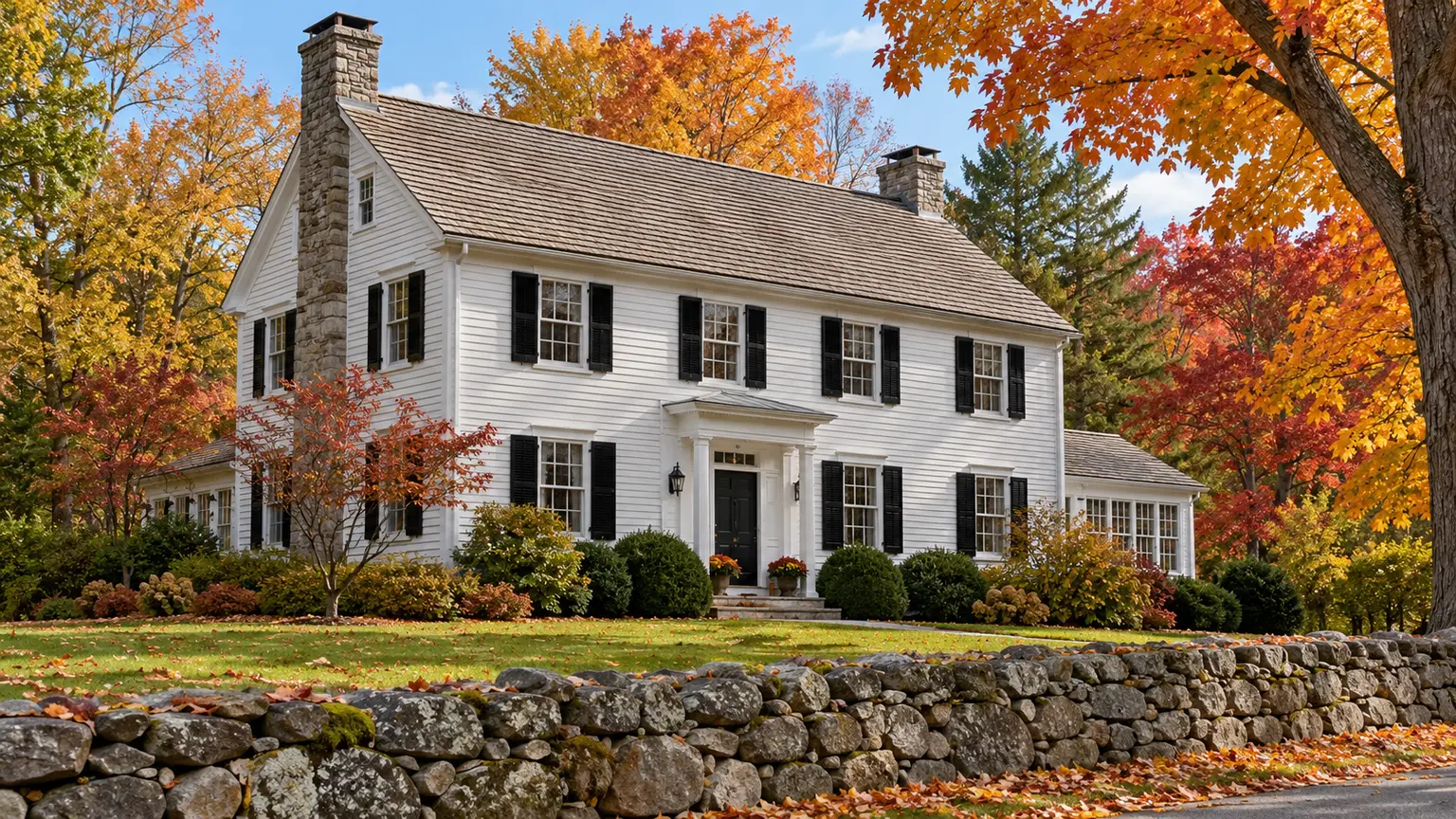
Half of the 12,737 homes in New London were built before 1945. The rules below decide how much of the old roof has to come off and what goes under the new one.
New Roofing Costs connects homeowners with independent local roofing contractors. We do not perform roofing work.
This number connects homeowners who are planning a new roof or a full roof replacement with independent local roofing contractors. It is not for leak repairs or patch jobs. The call must come from the homeowner who decides on the roof. Calls may be recorded.
The rules for a reroof in New London
Permit
Needed beyond a quarter of the roof
Without a permit, Connecticut allows only:
Repairs that are limited to 25 percent of roof covering and building siding within one calendar year.
2022 CSBC, (Amd) R105.2, item 11
A whole new roof is more than that, so it goes to New London’s building official.
A new roof may go over one existing layer; with two or more, or over slate, clay or cement tile, everything comes off to the deck (IRC R908.3.1.1). 83% of New London’s homes were built before 1980, so count the layers before comparing quotes.
Connecticut answers “yes” to the ice barrier for every town. It runs from the eave to 24 inches inside the exterior wall, more on steep roofs (IRC R905.1.2); check that the quote lists it.
Connecticut adds a 4-inch self-adhering strip over all joints of a plywood or OSB deck ((Amd) R905.1.1). It is not needed under a fully adhered membrane, or on board decks under 3 feet wide, which matters in a town where 47% of homes predate 1940.
New London’s code design values are a 127 mph ultimate design wind speed and a 30 psf ground snow load; it is in Connecticut’s hurricane-prone region. At that wind speed the code calls for asphalt shingles labeled ASTM D7158 Class G or H (Table R905.2.4.1).
Owners live in 4,260 of New London’s occupied homes, or 36%. By year built, 47% before 1940, 64% before 1960, 83% before 1980; 8% went up in 2000 or later. (ACS 2020–2024.)
By building type: 30% detached houses, 5% attached single-family houses (rowhouses, twins and townhouses), 30% buildings of two to four units.
On a house built before 1940, ask what the deck is (boards or plywood) and whether slate sits under the later layers: slate can’t be roofed over, and Connecticut’s joint-tape rule does not apply to narrow board decks.
Of the 21 New London County municipalities on this site, New London has the largest share of homes built before 1980: 83%, against a county range of 31% to 83%.
Median built: median year the homes were built. Before 1980: share of homes built then. Owners: share of homes that are owner-occupied. Row, twin: share of homes that are rowhouses, twins or townhouses. Census ACS 2020–2024. Hail days: days with hail of 1 inch or larger within 10 miles, 2006–2025, NOAA Storm Prediction Center.
Storm record around New London
Within 10 miles of New London, hail of an inch or more was reported on 4 days between 2006 and 2025, the biggest stones 1 in on June 29, 2020.
That is fewer than most places in the state on this site (median 9 days).
Remnants of Hurricane Ida (DR-4629, October 2021) is the latest of 10 federal storm declarations covering New London County since 2006. (OpenFEMA.)
Lifespans come from HUD’s capital-needs table, not from a brochure. More in the guides to shingles, metal, slate and flat roofs.
Material
HUD useful life
Fits a house like
Watch for
Asphalt shingles
20 years
Most pitched roofs; 30% of homes here are detached
Class G or H at 127 mph design wind (IRC Table R905.2.4.1)
Metal (standing seam, panels)
50 years
Simple roofs with long, unbroken slopes
Standing seam that carries its own loads can skip the tear-off (R908.3.1)
Slate
75 years
Older houses; 47% here predate 1940
Sound slate can be reused (R908.5); broken slate cannot
Flat roof: EPDM or TPO
15 years
Porches, additions, low-slope rears
Seams at walls and drainage
Checking a contractor in Connecticut
Look up the home improvement registration (C.G.S. § 20-420) of anyone pricing a roof in New London; the law forbids presenting it as an endorsement of workmanship (§ 20-427(b)(6)).
Does a roof replacement in New London need a permit?
Needed beyond a quarter of the roof. A whole new roof is more than that, so it goes to New London’s building official.
Can a new roof go over the old one in New London?
A new roof may go over one existing layer; with two or more, or over slate, clay or cement tile, everything comes off to the deck (IRC R908.3.1.1). 83% of New London’s homes were built before 1980, so count the layers before comparing quotes.
How old are the houses in New London?
By the Census Bureau’s American Community Survey (2020–2024), the median home in New London was built in 1945, 83% of homes were built before 1980, 36% are owner-occupied.
How many hail days has New London had?
Hail of 1 inch or larger was reported on 4 days within 10 miles of New London from 2006 through 2025 (NOAA Storm Prediction Center). A report means hail fell nearby, not that a roof was damaged.
How do I check a roofing contractor in New London?
Look up the home improvement registration (C.G.S. § 20-420) of anyone pricing a roof in New London; the law forbids presenting it as an endorsement of workmanship (§ 20-427(b)(6)).
What they will ask on the phone
The street address in New London, or at least the ZIP code
The number of stories, and whether the house stands alone
What covers the roof now and about when it went on
Whether there is one layer or more, if you know
That you want a new roof or a full replacement, and when you want the work done
Any historic-district or HOA rules on the house in New London