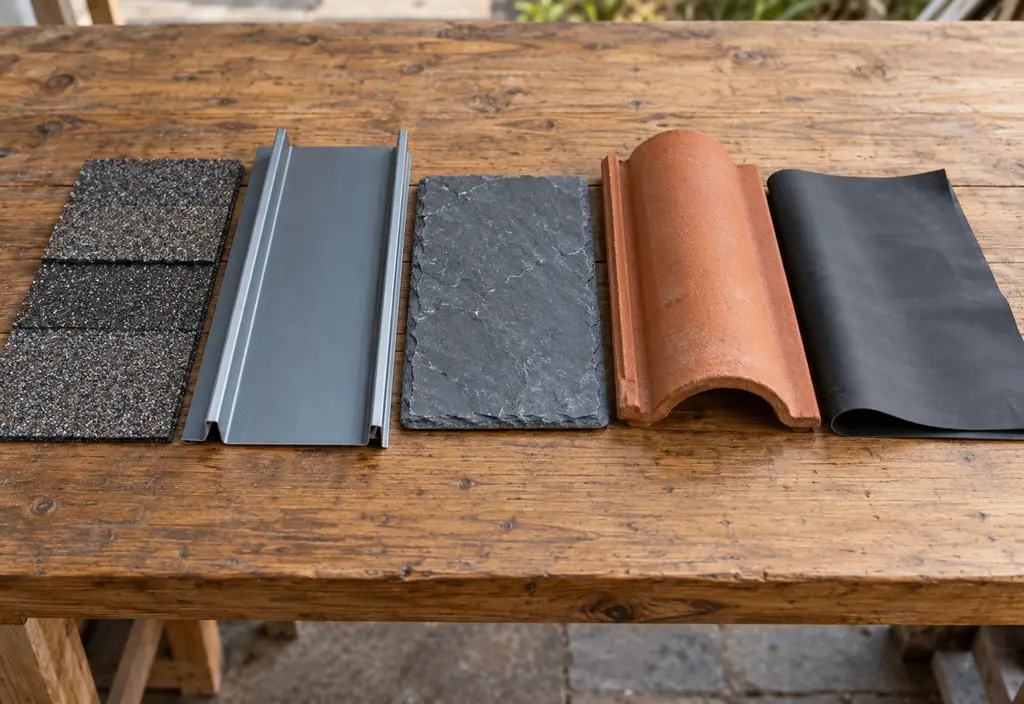
Side by side
| Material | HUD useful life | Can a new roof go over it? | Code points |
|---|---|---|---|
| Asphalt shingles | 20 years | Over one layer, not two (IRC R908.3.1.1) | Slope 2:12 or more; double underlayment to 4:12; wind class by town |
| Metal | 50 years | Standing-seam systems carrying their own loads may go over the old roof (R908.3.1) | Ice barrier rule covers metal shingles; product approval in Florida |
| Slate | 75 years | Never | Sound slate may be reinstalled; broken slate may not (R908.5) |
| Clay or concrete tile | 60 years | Never (R908.3.1.1; FBC-EB 706.3) | Product approval in Florida; HVHZ rules in Broward |
| Cedar shingles or shakes | 25 years | Not over wood shake in Florida (FBC-EB 706.3) | Ask about fire rules in your town |
| EPDM or TPO membrane | 15 years | Not over two layers or a wet roof | For low slopes below 2:12 |
| Built-up roof with gravel | 20 years | Not over two layers or a wet roof | Low slopes |
Useful life is HUD's planning figure for capital needs assessments, not a warranty and not a promise for any one roof.
A single leak on a roof with years of life left is usually a repair.
Choosing
- Pitched roof, most houses: asphalt shingles are the default; the wind class follows your town's design wind speed. Asphalt shingles.
- A roof you want to last, or solar ahead: metal. Metal roofing.
- An older or historic house with slate: slate again, synthetic slate, or another material if the historic commission allows. Slate roofs.
- Florida tile houses: tile again or a lighter covering; the framing decides. Tile roofs in Florida.
- Low-slope sections, porches, additions: a membrane system. Flat roof replacement.
What every material shares
Whatever goes on, the same code rules apply to the job: a tear-off where two layers are already on; an eave ice barrier in every town in Massachusetts, Connecticut and Rhode Island and in Sussex County, New Jersey; deck-joint tape in Connecticut; and in Florida, a secondary water barrier and deck re-nailing on site-built houses permitted before March 1, 2002. See what a roof replacement includes.
Questions
Which roofing material lasts the longest?
By HUD’s planning figures for capital needs assessments, slate lasts 75 years, clay or concrete tile 60, metal 50, cedar 25, asphalt shingles and built-up roofs with gravel 20, and EPDM or TPO membranes 15. These are planning figures, not a warranty or a promise for any one roof.
Which roofing materials can’t be covered with a new roof?
Slate and clay or concrete tile never serve as a base for a new layer. Asphalt shingles can take one new layer over one existing layer but not over two, and in Florida a new roof can’t go over wood shake either.
Which code rules apply whatever roofing material I choose?
A tear-off where two layers are already on; an eave ice barrier in every town in Massachusetts, Connecticut and Rhode Island and in Sussex County, New Jersey; deck-joint tape in Connecticut; and in Florida, a secondary water barrier and deck re-nailing on site-built houses permitted before March 1, 2002.