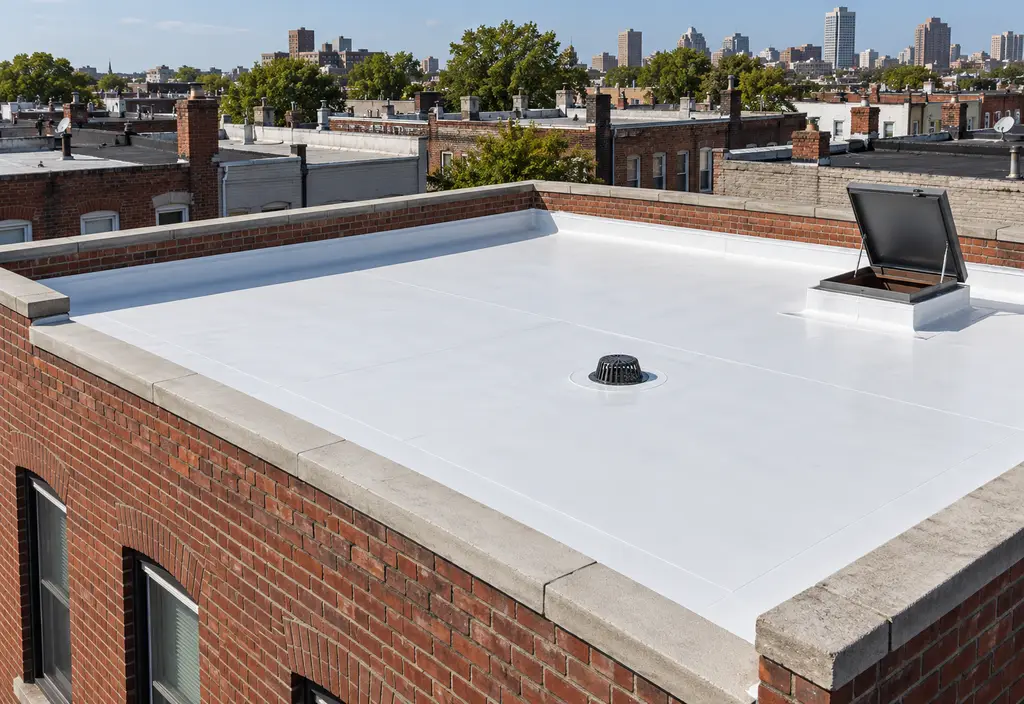
The systems
"Flat" roofs are low-slope roofs, too shallow for shingles (the code allows asphalt shingles only from a 2:12 slope, IRC R905.2.2). They are covered with a continuous membrane instead:
- EPDM, a synthetic rubber sheet, usually black.
- TPO, a thermoplastic sheet, usually white, with heat-welded seams.
- Modified bitumen, asphalt-based rolls with reinforcement, torched or self-adhered.
- Built-up roofing, layers of felt and asphalt, often finished with gravel.
How long each lasts
HUD's useful-life table for capital needs assessments plans:
| System | HUD useful life |
|---|---|
| EPDM | 15 years |
| TPO | 15 years |
| Built-up roof with gravel | 20 years |
| Built-up roof without gravel surfacing | 10 years |
HUD's table has no separate line for modified bitumen; ask for the manufacturer's data and warranty.
A single leak on a roof with years of life left is usually a repair.
Extending an old roof is a different job
Coatings are sold as a way to extend an old flat roof. That is a different job from replacement, and the number on this page is for replacements and new roofs.
Over the old membrane, or a tear-off
The same code rules apply as on a pitched roof: a recover is not allowed over two or more existing layers or over a water-soaked or deteriorated roof (IRC R908.3.1.1).
Where flat roofs are common
Low-slope sections turn up on porches, additions and rear sections of houses, and on some rowhouses and twins; ask the contractor which your house has. In Philadelphia, 56% of homes are attached single-family houses (Census ACS 2020–2024); see flat roofs on rowhouses. In Boston's 2025 roof permits for one- and two-family homes, "rubber" appears in 108 of 963 descriptions and "EPDM" in 50 (Analyze Boston).
What changes the price
The system; tear-off and how many layers; insulation and tapered insulation for drainage; drains and scuppers; where the roof meets walls and parapets; equipment that has to be lifted and reset; and access. See what sets the price.
Questions
What types of flat roof systems are there?
Low-slope roofs get a continuous membrane instead of shingles. The common systems are EPDM, a synthetic rubber sheet, usually black; TPO, a usually white thermoplastic sheet with heat-welded seams; modified bitumen, reinforced asphalt-based rolls that are torched or self-adhered; and built-up roofing, layers of felt and asphalt often finished with gravel.
How long does an EPDM or TPO roof last?
HUD’s useful-life table for capital needs assessments plans both EPDM and TPO at 15 years. A built-up roof is planned at 20 years with gravel surfacing and 10 without. HUD has no separate line for modified bitumen, so ask for the manufacturer’s data and warranty.
Can a new membrane go over an old flat roof?
The same code rules apply as on a pitched roof: a recover is not allowed over two or more existing layers, or over a roof that is water-soaked or deteriorated (IRC R908.3.1.1). In those cases the old roof comes off first.