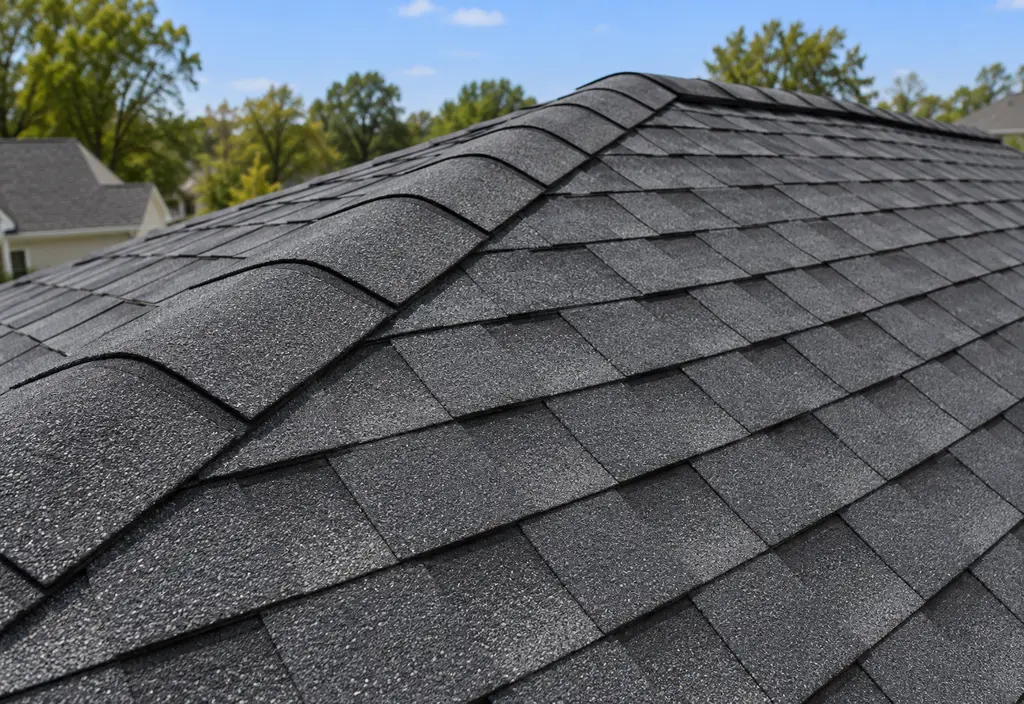
Three-tab and architectural
Asphalt shingles are the most common roof covering on the houses this site covers. Two kinds are sold:
- Three-tab shingles are a single flat layer with cutouts that make them look like three separate tabs.
- Architectural (laminated or dimensional) shingles are two or more layers bonded together, heavier and thicker, with an irregular look.
Both are made to the same product standard (ASTM D3462, which the residential code requires in R905.2.4). The difference that matters for a replacement is weight, wind performance and price, and the contractor can show you the product's labels for each.
A single leak on a roof with years of life left is usually a repair.
How long they last
HUD's useful-life table for capital needs assessments plans asphalt shingles at 20 years. The "30-year" or "lifetime" on a bundle is a warranty term with its own conditions, not a forecast; see roof warranties.
The wind class your town's code calls for
Shingles are tested for wind and labeled with a class. The residential code ties the class to the ultimate design wind speed (Vult) for the site (IRC Table R905.2.4.1):
| Design wind speed (Vult) | ASTM D7158 class | ASTM D3161 class |
|---|---|---|
| up to 116 mph | D, G or H | A, D or F |
| 117 to 129 mph | G or H | A, D or F |
| 130 to 155 mph | G or H | F |
| above 155 mph | H | F |
Connecticut amends the table to read its own Appendix AY wind speeds, with the same breakpoints. Massachusetts leaves the table as written.
Where to find your design wind speed:
- Massachusetts lists it for all 351 cities and towns (780 CMR 51.00, Table R301.2(2)): Worcester 117 mph, Boston 120, Springfield 115, Plymouth 127, Barnstable 130.
- Connecticut lists it for all 169 towns (2022 CSBC, Appendix AY): Hartford 120 mph, New Haven 125, New London 127.
- New Jersey, Pennsylvania, Rhode Island and Florida have no published town table; the value comes from the code's wind maps for the site, and the building department or contractor can give it.
Every Massachusetts and Connecticut town page on this site shows its own design wind speed and the class that follows.
Slope and underlayment
Asphalt shingles may go only on roofs with a slope of 2:12 or more. From 2:12 up to 4:12 the code requires a double layer of underlayment (IRC R905.2.2). Below 2:12, a flat-roof system is the answer: see flat roof replacement.
Over the old shingles, or a tear-off
A new layer of shingles may go over one existing layer. If the roof already has two, or the old covering is slate or tile, or the roof is water-soaked, everything comes off to the deck (IRC R908.3.1.1). In Massachusetts, Connecticut and Rhode Island, a recover also has to get the eave ice barrier the code requires there. More: tear-off or roof over.
What changes the price of a shingle roof
Architectural against three-tab; the wind class; a tear-off and how many layers; deck sheets replaced; ice barrier and, in Connecticut, deck-joint tape; the pitch and the number of valleys and penetrations. See what sets the price.
Questions
How long do asphalt shingles last?
HUD’s useful-life table for capital needs assessments plans an asphalt shingle roof at 20 years. The “30-year” or “lifetime” printed on a bundle is the term of a warranty with its own conditions, not a forecast of how long the roof will last.
What is the difference between three-tab and architectural shingles?
Three-tab shingles are a single flat layer with cutouts that make each one look like three tabs. Architectural, also called laminated or dimensional, shingles bond two or more layers together, so they are heavier and thicker with an irregular look. Both meet the same product standard, ASTM D3462; they differ in weight, wind performance and price.
What wind rating do shingles need for my town?
The residential code ties the shingle wind class to the site’s ultimate design wind speed (IRC Table R905.2.4.1). Up to 116 mph, ASTM D7158 class D, G or H qualifies; from 117 to 155 mph, G or H; above 155 mph, only H. Massachusetts and Connecticut list the design wind speed for every town; elsewhere the building department or contractor can give it.
What is the minimum roof pitch for asphalt shingles?
Asphalt shingles may go only on roofs with a slope of 2:12 or more. Between 2:12 and 4:12 the code calls for a double layer of underlayment (IRC R905.2.2), and below 2:12 a flat-roof membrane system is used instead.