Permit
Ask Wind Gap first
The state code does not cover a reroof that changes no structure (34 Pa. Code § 403.1(b)(8)). The borough code office can say what Wind Gap requires.
Source: 34 Pa. Code § 403.1(b)
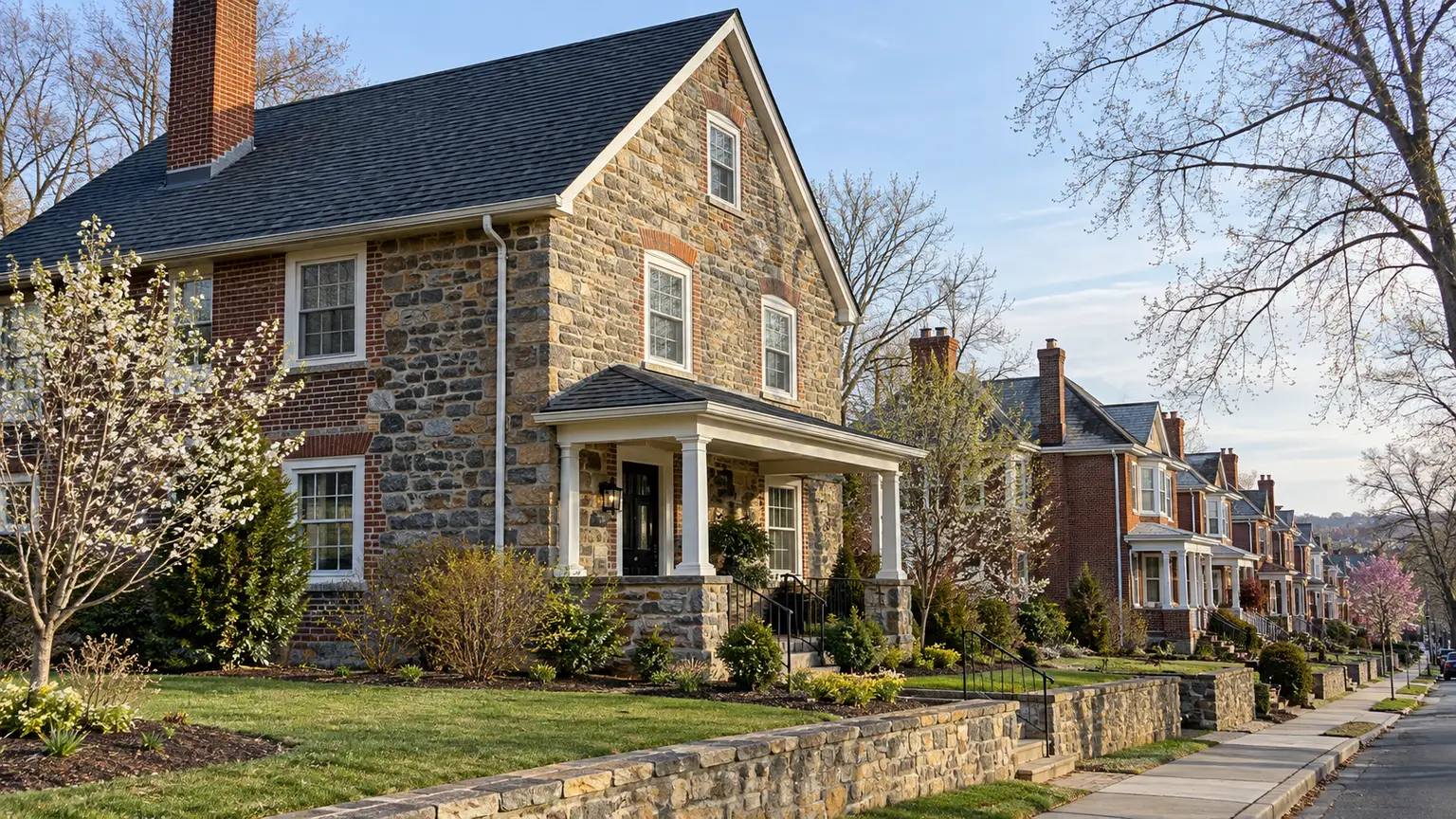
Wind Gap has 1,511 homes, and half of them were standing by 1964. What the code requires when that roof is replaced, and who signs off, is below.
New Roofing Costs connects homeowners with independent local roofing contractors. We do not perform roofing work.
This number connects homeowners who are planning a new roof or a full roof replacement with independent local roofing contractors. It is not for leak repairs or patch jobs. The call must come from the homeowner who decides on the roof. Calls may be recorded.
Permit
The state code does not cover a reroof that changes no structure (34 Pa. Code § 403.1(b)(8)). The borough code office can say what Wind Gap requires.
Source: 34 Pa. Code § 403.1(b)
Layers
On a roof that already carries two layers, or slate or tile, the code allows no recover: it is a tear-off (IRC R908.3.1.1). With 71% of Wind Gap’s homes were built before 1980, ask what is under the newest layer.
Ice barrier
Whether an eave membrane is a code item depends on the climate table the municipality filled in when it adopted the code (IRC R905.1.2, Table R301.2). Ask the borough code office or the contractor what Wind Gap’s says.
Checked against the code text on October 24, 2026. Code edition, permit and contract rules for the whole state: roof replacement in Pennsylvania.
Owners live in 757 of Wind Gap’s occupied homes, or 50%. Counting by decade, 32% before 1940, 45% before 1960, 71% before 1980 of the housing was in place, and 9% dates from 2000 on. (ACS 2020–2024.)
The housing is 45% detached houses, 22% attached single-family houses (rowhouses, twins and townhouses), 7% buildings of two to four units.
Older houses hide their history: ask the contractor to confirm the deck (board or sheet) and every layer above it before pricing, because slate or two layers mean a full tear-off.
Of the 34 Northampton County municipalities on this site, Wind Gap has the 14th largest share of homes built before 1980: 71%, against a county range of 20% to 91%.
| Place | Median built | Before 1980 | Owners | Row, twin | Hail days |
|---|---|---|---|---|---|
| Wind Gap | 1964 | 71% | 50% | 22% | 6 |
| Pen Argyl | 1938 | 86% | 74% | 40% | 8 |
| Plainfield | 1970 | 63% | 78% | 11% | 10 |
| Bushkill | 1987 | 42% | 92% | 1% | 10 |
| Ross Township, Monroe County | 1984 | 35% | 93% | 1% | 6 |
| Roseto | 1941 | 82% | 75% | 6% | 5 |
Median built: median year the homes were built. Before 1980: share of homes built then. Owners: share of homes that are owner-occupied. Row, twin: share of homes that are rowhouses, twins or townhouses. Census ACS 2020–2024. Hail days: days with hail of 1 inch or larger within 10 miles, 2006–2025, NOAA Storm Prediction Center.
Within 10 miles of Wind Gap, hail of an inch or more was reported on 6 days between 2006 and 2025, the biggest stones 1.25 in on July 9, 2014. The most recent was May 19, 2019.
That is fewer than most places in the state on this site (median 12 days).
Northampton County has had 6 federal major-disaster declarations for storms since 2006; the latest was DR-4618, Remnants of Hurricane Ida (September 2021). (OpenFEMA.)
Storm reports are what observers logged, not a measure of damage to any roof. When wind or hail damage means a new roof.
Lifespans come from HUD’s capital-needs table, not from a brochure. More in the guides to shingles, metal, slate and flat roofs.
| Material | HUD useful life | Fits a house like | Watch for |
|---|---|---|---|
| Asphalt shingles | 20 years | Most pitched roofs; 45% of homes here are detached | Wind class set by the design wind speed (IRC Table R905.2.4.1) |
| Metal (standing seam, panels) | 50 years | Roofs that will carry solar later | A complete standing-seam system may go over the old roof (R908.3.1) |
| Slate | 75 years | Older houses; 32% here predate 1940 | Never a base for a new layer (R908.3.1.1); heavy |
| Flat roof: EPDM or TPO | 15 years | Low-slope roofs and rear sections (22% of homes here are attached) | Where the roof meets a wall or parapet |
Pennsylvania’s home improvement law (HICPA § 3, § 6) requires registration with the Attorney General from $5,000 a year of such work and puts the number on every estimate; ask for it in Wind Gap and look it up.
Contracts, deposits and the right to cancel: checking a roofing contractor. What moves the price: new roof cost in Pennsylvania.
Ask Wind Gap first. The state code does not cover a reroof that changes no structure (34 Pa. Code § 403.1(b)(8)). The borough code office can say what Wind Gap requires.
On a roof that already carries two layers, or slate or tile, the code allows no recover: it is a tear-off (IRC R908.3.1.1). With 71% of Wind Gap’s homes were built before 1980, ask what is under the newest layer.
By the Census Bureau’s American Community Survey (2020–2024), the median home in Wind Gap was built in 1964, 71% of homes were built before 1980, 50% are owner-occupied.
Hail of 1 inch or larger was reported on 6 days within 10 miles of Wind Gap from 2006 through 2025 (NOAA Storm Prediction Center). A report means hail fell nearby, not that a roof was damaged.
Pennsylvania’s home improvement law (HICPA § 3, § 6) requires registration with the Attorney General from $5,000 a year of such work and puts the number on every estimate; ask for it in Wind Gap and look it up.
The full list: before you call.
Checked October 24, 2026. Laws and code editions change; the date says when these were last read at the source.