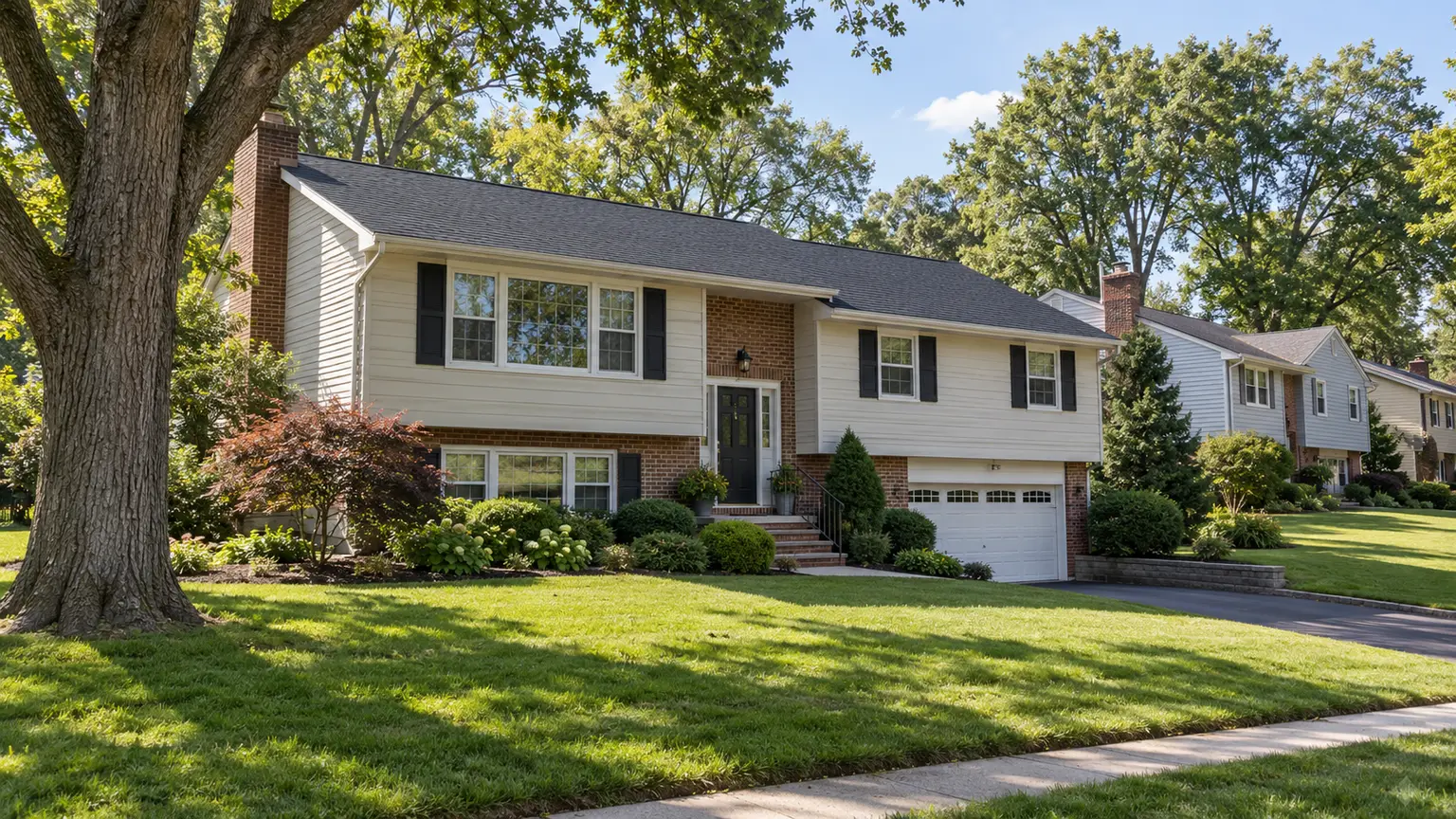
Parsippany-Troy Hills has 23,622 homes, and half of them were standing by 1969. Below: what the code asks of a replacement here, the permit, and the town’s own records.
New Roofing Costs connects homeowners with independent local roofing contractors. We do not perform roofing work.
This number connects homeowners who are planning a new roof or a full roof replacement with independent local roofing contractors. It is not for leak repairs or patch jobs. The call must come from the homeowner who decides on the roof. Calls may be recorded.
The rules for a reroof in Parsippany-Troy Hills
Permit
Detached houses: no permit, no notice
Replacing the covering on a detached one- or two-family house needs no permit and no notice to the town (N.J.A.C. 5:23-2.7). That covers the 52% of Parsippany-Troy Hills’s homes that are detached; twins, rowhouses, townhouses and structural work are outside it.
The state strikes the IRC reroof definitions from its code (N.J.A.C. 5:23-3.21) and leaves existing houses to the Rehabilitation Subcode, not yet checked here. 72% of Parsippany-Troy Hills’s homes were built before 1980, so get the layer count and a tear-off price in writing.
New Jersey requires the eave membrane only where January averages 25 °F or colder, which the state says is Sussex County (DCA Bulletin 07-3). In Parsippany-Troy Hills it is the installer’s and the manufacturer’s call; ask whether the quote includes it.
60% of the occupied homes in Parsippany-Troy Hills are lived in by their owners: 13,746 households, the people this line is for. By year built, 5% before 1940, 24% before 1960, 72% before 1980; 10% went up in 2000 or later. (ACS 2020–2024.)
By building type: 52% detached houses, 7% attached single-family houses (rowhouses, twins and townhouses), 7% buildings of two to four units.
Of the 39 Morris County municipalities on this site, Parsippany-Troy Hills has the 10th largest share of homes built before 1980: 72%, against a county range of 42% to 87%.
Median built: median year the homes were built. Before 1980: share of homes built then. Owners: share of homes that are owner-occupied. Row, twin: share of homes that are rowhouses, twins or townhouses. Census ACS 2020–2024. Hail days: days with hail of 1 inch or larger within 10 miles, 2006–2025, NOAA Storm Prediction Center.
Storm record around Parsippany-Troy Hills
Since 2006 the National Weather Service has logged hail of 1 inch or larger on 12 separate days within 10 miles of Parsippany-Troy Hills; the largest was 1.75 in on July 7, 2013. The most recent was September 9, 2023.
Remnants of Hurricane Ida (DR-4614, September 2021) is the latest of 11 federal storm declarations covering Morris County since 2006. (OpenFEMA.)
Lifespans come from HUD’s capital-needs table, not from a brochure. More in the guides to shingles, metal, slate and flat roofs.
Material
HUD useful life
Fits a house like
Watch for
Asphalt shingles
20 years
Most pitched roofs; 52% of homes here are detached
Wind class set by the design wind speed (IRC Table R905.2.4.1)
Metal (standing seam, panels)
50 years
Roofs that will carry solar later
Standing seam that carries its own loads can skip the tear-off (R908.3.1)
Slate
75 years
Older houses; 5% here predate 1940
Sound slate can be reused (R908.5); broken slate cannot
Flat roof: EPDM or TPO
15 years
Porches, additions, low-slope rears
Where the roof meets a wall or parapet
Checking a contractor in New Jersey
New Jersey had 47,473 active home improvement registrations in October 2026; the one belonging to whoever quotes your roof in Parsippany-Troy Hills should be on the contract (N.J.S.A. 56:8-144).
Questions about a new roof in Parsippany-Troy Hills
Do I need a permit to replace a roof in Parsippany-Troy Hills?
Detached houses: no permit, no notice. Replacing the covering on a detached one- or two-family house needs no permit and no notice to the town (N.J.A.C. 5:23-2.7). That covers the 52% of Parsippany-Troy Hills’s homes that are detached; twins, rowhouses, townhouses and structural work are outside it.
How old are the houses in Parsippany-Troy Hills?
By the Census Bureau’s American Community Survey (2020–2024), the median home in Parsippany-Troy Hills was built in 1969, 72% of homes were built before 1980, 60% are owner-occupied.
How often does hail hit Parsippany-Troy Hills?
Hail of 1 inch or larger was reported on 12 days within 10 miles of Parsippany-Troy Hills from 2006 through 2025 (NOAA Storm Prediction Center). A report means hail fell nearby, not that a roof was damaged.
How do I check a roofing contractor in Parsippany-Troy Hills?
New Jersey had 47,473 active home improvement registrations in October 2026; the one belonging to whoever quotes your roof in Parsippany-Troy Hills should be on the contract (N.J.S.A. 56:8-144).
What they will ask on the phone
Your address or ZIP code in Parsippany-Troy Hills
How many stories the house has, and whether it is detached or attached
The roof you have today, shingle, metal, slate, tile or flat, and its rough age
The number of layers, if anyone has counted
Your timing for a complete replacement
Any historic-district or HOA rules on the house in Parsippany-Troy Hills