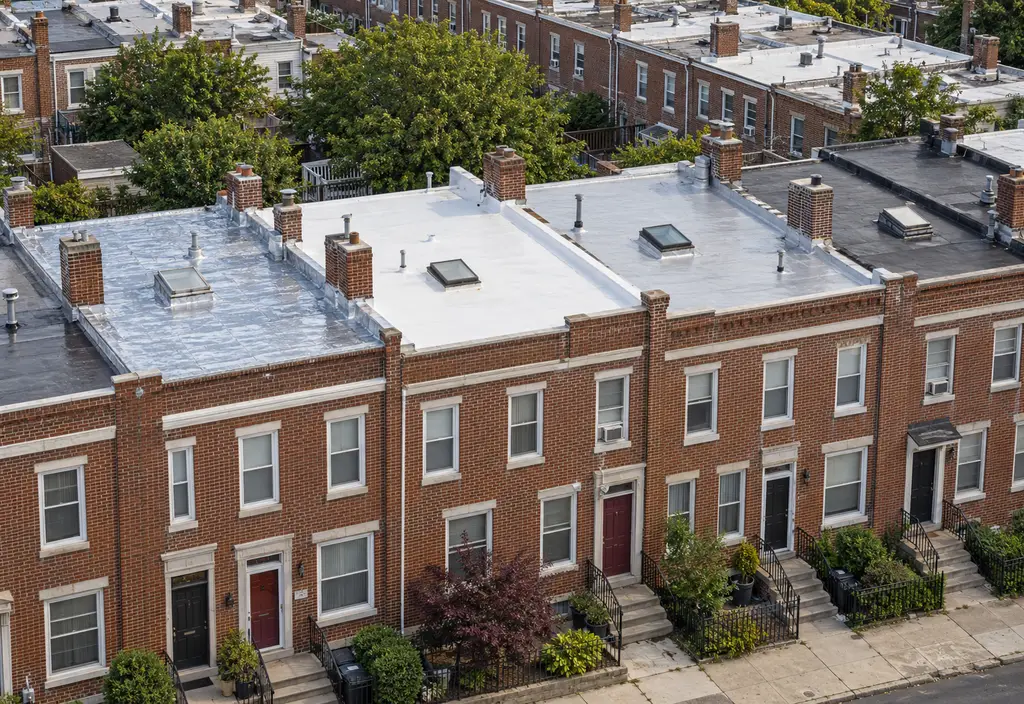
Whose house this is
In Philadelphia County, 76.7% of owner-occupied homes are attached single-family houses, rowhouses and twins, and 39.9% of all housing was built before 1940 (Census ACS 2020–2024). In some ZIP codes, such as 19149 in the Northeast, about 80% of homes are attached. In Reading and Lancaster about half of all housing is attached single-family; in Allentown, about a third. Each town page on this site gives its own share.
The Census counts houses, not roof shapes. Ask the contractor what your roof is: low-slope membrane, pitched shingle, or both front and back.
The systems
On low-slope roofs: EPDM rubber, white TPO, modified bitumen, or built-up roofing. HUD's useful-life table for capital needs assessments gives EPDM and TPO 15 years, and a built-up roof 20 years with gravel or 10 without. Flat roof replacement explains each. A coating applied over the old roof is a different job from a replacement.
Tear-off or recover
The code Pennsylvania adopted allows a new layer over one existing layer only, and never over a water-soaked roof (IRC R908.3.1.1). New Jersey's layer rule for existing houses is in its Rehabilitation Subcode, which this site has not read yet. Ask how many layers are on the roof and how the quote handles the deck. Philadelphia's reroof certification asks whether less than 10% of the sheathing was replaced (form TP_019_F).
The party wall
On an attached house the roof meets the neighbor's at the party wall. Say so on the call, and ask the contractor how the new roof will be tied in where it meets the house next door, and whether the neighbor needs to know before work starts.
The permit
- Philadelphia: roof covering replacement is an EZ permit, no plans needed. The fee for "Roof Covering (replacement only)" on a one- or two-family dwelling is $69. The contractor certifies the job afterwards on form TP_019_F.
- New Jersey: the no-permit rule for a new roof covering (N.J.A.C. 5:23-2.7) names detached one- and two-family houses. A rowhouse, twin or townhouse is outside it, so expect to file with the construction office.
How many roofs are replaced in Philadelphia
In 2025 the City issued 2,334 EZ permits for roof covering replacement. ZIP 19143 had the most, 191, followed by 19145 (138), 19140 (129), 19132 (117), 19120 (107) and 19124 (104); 19127 had 3 (OpenDataPhilly, L&I permits). The table has no job values.
The contractor
In Pennsylvania a contractor with $5,000 or more of home improvement work a year registers with the Attorney General, and the number goes on every contract and estimate (HICPA § 3, § 6). In Philadelphia, work on an existing one- or two-family house also needs the City's "PA Home Improvement" registration: 555 were active on October 22, 2026. The contract can be cancelled within three business days of signing, wherever it was signed, and on a job over $5,000 the deposit can't exceed one-third of the price plus special-order materials (HICPA § 7(b), § 9). Checking a roofing contractor.
Roof replacement in Philadelphia.
Questions
Do I need a permit to replace a rowhouse roof in New Jersey?
Expect to file with the construction office. New Jersey’s no-permit rule for a new roof covering names detached one- and two-family houses, so a rowhouse, twin or townhouse falls outside it.
What should I ask about the party wall on a rowhouse roof?
On an attached house the roof meets the neighbor’s at the party wall. Ask the contractor how the new roof will be tied in where it meets the house next door, and whether the neighbor needs to know before work starts.
What kind of roof does a Philadelphia rowhouse have?
The Census counts houses, not roof shapes, so ask the contractor: it may be a low-slope membrane, pitched shingle, or both front and back. Low-slope sections are covered with EPDM rubber, white TPO, modified bitumen or built-up roofing.
How many roofs are replaced in Philadelphia each year?
In 2025 the City issued 2,334 EZ permits for roof covering replacement. ZIP 19143 had the most, 191, followed by 19145 with 138 and 19140 with 129.