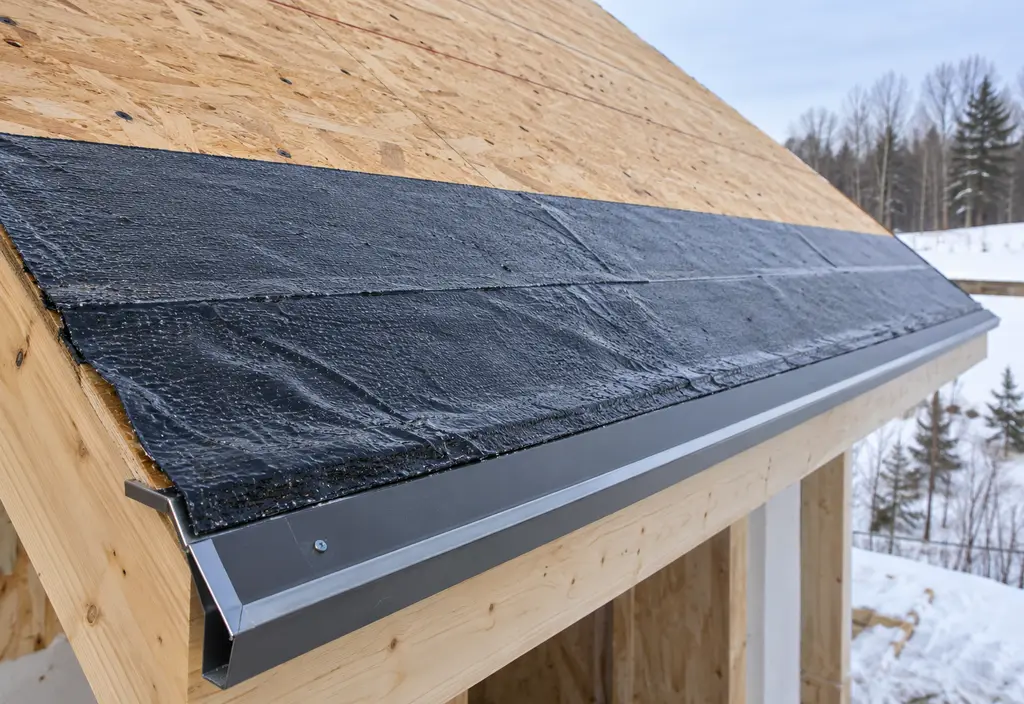
This page is about the membrane the code requires under a new roof at the eaves. It is not about clearing ice off a roof, which is a different kind of call.
What the code means by an ice barrier
The ice barrier shall consist of not fewer than two layers of underlayment cemented together, or a self-adhering polymer-modified bitumen sheet shall be used in place of normal underlayment and extend from the lowest edges of all roof surfaces to a point not less than 24 inches (610 mm) inside the exterior wall line of the building. On roofs with slope equal to or greater than 8 units vertical in 12 units horizontal (67-percent slope), the ice barrier shall also be applied not less than 36 inches (914 mm) measured along the roof slope from the eave edge of the building.
The rule covers asphalt shingles, metal roof shingles, mineral-surfaced roll roofing, slate and slate-type shingles, and wood shingles and shakes. It applies "as designated in Table R301.2," the climate table each state fills in.
Where it is required
| State | Ice barrier in the code | Source |
|---|---|---|
| Massachusetts | Yes, every town | 780 CMR 51.00, Table R301.2(1) |
| Connecticut | Yes, every town | 2022 CSBC, Table R301.2 |
| Rhode Island | Yes, every town | SBC-2, Table R301.2(1): "Ice Shield Underlayment Required: Yes" |
| New Jersey | Sussex County only | N.J.A.C. 5:23-3.21(c)8.ii; DCA Bulletin 07-3 |
| Pennsylvania | Where the municipality's table says so | IRC R905.1.2, Table R301.2 as adopted locally |
| Florida | Not applicable | Florida's older-house reroofs get a secondary water barrier instead |
New Jersey replaces the IRC's wording with "In areas where the average daily temperature in January is 25°F (-4°C) or less," and its Bulletin 07-3 says: "For the State of New Jersey, this area is Sussex County." Elsewhere in New Jersey an ice barrier is the installer's and the manufacturer's call, not a code item.
Connecticut adds tape on every deck joint
Connecticut's amendment to R905.1.1 requires a 4-inch strip of self-adhering membrane over all joints in the roof deck, under the underlayment. It is not required where the whole deck gets a self-adhered membrane, or on board decks of lumber less than 3 feet wide. On a plywood or OSB deck it is a line on the quote that other states don't have.
Snow by town
Massachusetts publishes a design ground snow load for each of its 351 cities and towns, from 25 to 60 psf (780 CMR 51.00, Table R301.2(2)). Connecticut's Appendix AY gives 30 to 40 psf by town. Every town page on this site for those two states shows its value.
On a reroof
- An ice barrier already adhered to the deck may stay and be covered with a new layer of ice barrier (IRC R908.3, exception).
- On a recover over one existing layer, ask how the ice barrier requirement will be met; it is part of the code wherever the table says "yes."
- Ask for the ice barrier as its own line on the quote, with how far up the roof it runs.
Ice dams
The code's own wording explains why the barrier exists: areas "where there has been a history of ice forming along the eaves causing a backup of water" (IRC R905.1.2). The membrane goes under the new covering along those eaves. Ask the contractor replacing the roof whether the attic ventilation is part of the job as well. What a replacement includes.
Questions
What is an ice barrier on a roof?
It is a self-adhering polymer-modified bitumen sheet, or at least two layers of underlayment cemented together, laid from the bottom edges of every roof surface to at least 24 inches inside the exterior wall line (IRC R905.1.2). On roofs of 8:12 or steeper it also runs at least 36 inches up the slope from the eave.
Which states require an ice barrier on a new roof?
Massachusetts, Connecticut and Rhode Island require it in every town. New Jersey requires it only in Sussex County, where the average daily January temperature is 25°F or less; Pennsylvania requires it where the municipality’s climate table says so. In Florida it does not apply.
What is Connecticut’s deck-joint tape rule?
Connecticut requires a 4-inch strip of self-adhering membrane over every joint in the roof deck, under the underlayment ((Amd) R905.1.1). It is not needed where the whole deck gets a self-adhered membrane, or on board decks of lumber less than 3 feet wide.
Can the old ice barrier stay when a roof is replaced?
Yes. An ice barrier already adhered to the deck may stay in place and be covered with a new layer of ice barrier (IRC R908.3, exception).